Capped Extraction Model
Quick Summary
Local is a cooperative food delivery network. It replaces platforms like DoorDash, Bolt and Uber Eats with a network owned by the restaurants and delivery operators who use it. Merchants pay a 10% co-op fee instead of 20–30%. There are no external shareholders.
Generation One (G1) builds the platform, establishes the cooperative in each territory, and hands ownership to the merchants. G1 is the builder, not the platform. This document explains how that buildout is funded and why extraction has a hard limit.
How the model works:
- A lifetime extraction cap is set for each territory, based on roughly €20–50 per resident.
- Investors put in approximately 30% of that cap and receive roughly 3× back as the cap fills.
- The 10% co-op fee splits two ways: 7% funds operations permanently, 3% flows to a ring-fenced cap fund that repays investors monthly.
- Once the cap is reached, the 3% stream switches off permanently. The cooperative runs the network at cost from that point forward.
- 90% of the cap goes to investors. 10% goes to G1 to fund the next territory.
Paris example: €340m lifetime cap. ~€100m raised from investors. ~€306m returned over approximately 46 months at full volume. After the cap: zero extraction, forever.
Global scale: 500–600 territories, €20–30 billion total lifetime cap, collected over roughly 5 years, then the entire network runs at cost.
Context: As of early 2026, Local is live in Malta. The platform and technology are operational, the app is on the app store, and drivers are being assigned to deliveries. We are in the very early stages, but the system is working under real market conditions.
Definitions
| Term | Meaning |
|---|---|
| GOV (gross order value) | The total value of orders processed through the network, before any fees are deducted. |
| Co-op fee | The percentage of GOV collected to run the network. Currently set at 10%. |
| Operations slice (7% of GOV) | The portion of the co-op fee that funds ongoing network operations and support. This continues permanently. |
| Cap fund (3% of GOV) | A ring-fenced collection stream used to repay launch investors and fund G1. This stream stops permanently once the territory cap is reached. |
| Territory cap (extraction cap) | The maximum cumulative amount that can ever be collected into the cap fund for a given territory. Once reached, the cap fund switches off. |
| Investor return pool (90% of cap) | The portion of the territory cap distributed pro-rata to investors via monthly payments as the cap fund fills. |
| G1 allocation (10% of cap) | Reserved for Generation One to fund the next territory build-out and ongoing project maintenance. Paid at the cap event, after investors have been repaid. |
| Cap event | The point at which cumulative cap-fund collections reach the territory cap. The 3% stream is switched off permanently and the G1 allocation is paid. |
| Post-cap | After the cap event: investor-linked collections are zero and the co-op fee can fall to a cost-only level set by members (target 3–4%). |
How fees flow
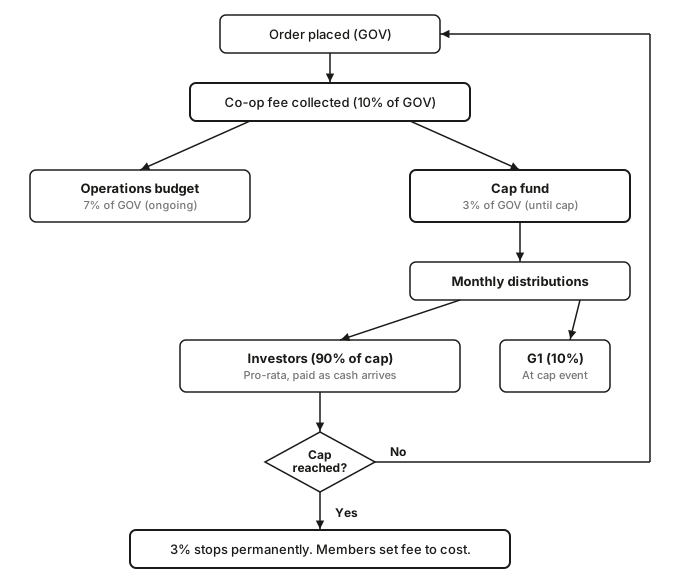
- Order placed (GOV)
- Co-op fee collected (10% of GOV)
- Fee splits into:
- Operations budget — 7% of GOV (ongoing)
- Cap fund — 3% of GOV (until cap)
- Cap fund flows to monthly distributions:
- Investors (90% of cap) — pro-rata, paid as cash arrives
- G1 (10%) — at cap event
- Cap reached?
- No → cycle continues from next order
- Yes → 3% stops permanently. Members set fee to cost.
The Problem
Every major delivery platform enters a market, builds a network, and then extracts from it indefinitely. Fees climb, margins collapse, restaurants close, drivers burn out. The extraction never ends.
Businesses cannot survive 20–30% commissions, and many are already closing. The model these platforms depend on is destroying the very ground they extract from: the restaurants, the drivers, the local economies that generate the orders.
Investors who back these platforms are being led towards a cliff. The extraction model is not sustainable, and public frustration is building visibly.
The Principle
Local One (the delivery network, referred to throughout as Local) replaces endless extraction with a hard cap. We set a single number per place (city, town, region or small country). Once reached, extraction stops and the cooperative takes over, running the network at cost permanently. Each place gets a lifetime extraction figure based on population, local spending habits, market density and competition. The baseline formula is simple:
Extraction cap = population × ~€50 per person
That is roughly 25 delivery orders at €2 fee revenue each (on an average order of ~€20 at 10% co-op fee).
This is conservative, grounded, and deliberately below what the market can sustain. The €50 figure is a ceiling, not a target; in practice we expect most caps to land between €20–50 per person, adjusted per place based on local conditions.
How the Investment Works
We set a lifetime cap for a place, raise approximately 30% of that cap from investors, and repay them roughly 3× their stake as the cap is reached. 10% of the total cap goes to Generation One (the organisation) to fund the next territory; the remaining 90% forms the investor return pool. The collection mechanism is a 10% co-op fee on gross order value (GOV), of which 3% flows to the cap fund and 7% funds co-op operations.
Paris metro: worked example
Paris metro area has approximately 12 million residents and roughly €3 billion in gross annual delivery revenue. The cap for Paris is set at €340m, which works out to approximately €28 per person: well below the €50 ceiling. This equals roughly 4 years of the incumbents' actual EBITDA (earnings before interest, taxes, depreciation and amortisation) for the region. We do not need more than €100m in investment to launch this region, and there is no reason to extract more than is required.
| Item | Amount |
|---|---|
| Lifetime extraction cap | €340m |
| Generation One (10% of cap) | €34m |
| Available for investor return | €306m |
| Investor raise (~30% of cap) | ~€100m |
| Investor return | €306m (approximately 3×) |
| Collection rate | 10% co-op fee (3% investor slice) |
| Annual collection | ~€90m |
| Time to reach cap (at full volume) | ~3.8 years (~46 months) |
Investors put in ~€100m. At full volume the 3% cap-fund slice collects approximately €90m per year, filling the €340m cap in roughly 3.8 years (~46 months). Of that, €34m goes to Generation One and €306m returns to investors: approximately 3× their original stake. The remaining 7% (~€210m per year at scale) funds co-op operations permanently.
After the cap is reached, extraction drops to zero. The cooperative owns and operates the network at cost, permanently.
Volume ramp: The €3b GOV figure assumes full market capture. In practice, starting with €500m–1b in Year 1 from leading merchants and reaching the €90m annual cap-fund collection by Year 3–4 is more realistic. The ~3× investor return (approximately 38% IRR) still holds over 5 years at that pace.
Operations: The 7% co-op operations slice (~€210m per year at full volume) covers AI-driven logistics and support at a fraction of legacy platform overheads. The ~€100m raise covers network buildout, early liquidity subsidies and merchant onboarding, after which the network self-funds.
Repayment Structure
Investors are repaid monthly, pro-rata, from a single ring-fenced fund as cash arrives from the network. This is not a lump sum at the end.
Paris at 3% investor slice: approximately €7.5m flows into the cap fund each month at full volume. Investors receive their share as it comes in. At that rate the fund reaches €340m in roughly 46 months, with €306m returned to investors and €34m to Generation One.
If the cap is not reached on schedule, we keep collecting the 3% cap-fund slice until we hit it. There is no cut-off and no bailout. The repayment mechanism is deterministic: a fixed percentage of every order flows into the cap fund until the cap is reached. The main uncertainty is the pace of adoption, which determines how long that takes. If a territory fails entirely (orders fall to zero permanently), repayments would stop.
The 10% to Generation One goes to the organisation itself, not to individuals or backers. Generation One uses it to seed the next territory, refine the technology, and fund ongoing operations.
Context: Investors receive a targeted ~3× return with early-mover positioning in an age when the public is actively walking away from corporate extraction. The network they help build outlasts their involvement.
Extraction Tiers
| Tier | Population | Cap per Place | Example |
|---|---|---|---|
| Small | Up to 500,000 | €10m–€25m | Malta, Reykjavik |
| Medium | 500,000 to 2m | €25m–€75m | Lisbon, Beirut |
| Large | 2m to 10m | €50m–€250m | Barcelona, Milan |
| Mega | 10m and above | €200m–€600m | Paris metro, London metro, Tokyo metro |
Caps are adjusted per place based on local data, kept within ~€20–50 per resident. The tiers are a starting framework, not a rigid rule. Total across 500–600 places at an average of €40–50m: approximately €20–30 billion lifetime.
Context: UN World Urbanization Prospects 2025 identifies over 12,000 cities with populations above 50,000, supported by data from Demographia and World Population Review. The initial fund targets only 500–600 of these, leaving substantial room for error or correction.
Current platform extraction (rough estimates)
Exact figures are difficult to verify. Major platforms do not publish city-level revenue or profit data, and their public filings report globally or by broad region. The estimates below are derived from national market data, population share, and urban density weighting. Platform EBITDA is estimated at 2–5% of gross order value, consistent with reported margins from DoorDash (approximately 3% on $25b quarterly GOV) and Just Eat (approximately 3.4%).
| City / Region | Population | Est. Gross Order Volume (annual) | Est. Platform EBITDA at 3% | Our Lifetime Cap | Cap as Multiple of Annual EBITDA |
|---|---|---|---|---|---|
| Malta | 500,000 | ~€120m | ~€3.6m | €25m | ~7× |
| Lisbon metro | 2.8m | ~€800m | ~€24m | €50m | ~2× |
| Barcelona metro | 5.5m | ~€1.5b | ~€45m | €100m | ~2× |
| Milan metro | 5.2m | ~€1.4b | ~€42m | €100m | ~2× |
| Paris metro | 12m | ~€3b | ~€90m | €340m | ~4× |
| London metro | 14m | ~€4b | ~€120m | €600m | ~5× |
| Tokyo metro | 37m | ~€8b | ~€240m | €600m | ~2.5× |
Our cap for Paris equals roughly 4 years of the incumbents' actual city-level profit, collected gently over a similar timeframe at 3% investor slice, after which extraction ends permanently. Incumbents continue extracting indefinitely.
Napkin Maths: How We Derived the Numbers
The figures below draw on three types of input. Measured data comes from public filings, industry reports and official statistics (cited in the References section). Local estimates are derived from first-hand market knowledge and merchant conversations where published data is unavailable. Modelling assumptions are forward-looking inputs (such as adoption rates and post-cap fee levels) that we believe are reasonable but have not yet been validated at scale.
The existing market
France's online food delivery market sits at approximately €12b in gross order volume (2023), projected towards €13–15b by 2026 (Grand View Research). An average order value of €20–25 yields roughly 550 million orders per year nationwide. The global market is projected at $280–350b by 2026 (Mordor Intelligence, Precedence Research, Fortune Business Insights). Capturing a modest share across 500–600 locations (from the UN's 12,000+ cities above 50,000 population) funds the model sustainably.
Malta as a ground-level estimate
Malta is a very small territory, used as a prototype to demonstrate the effectiveness of both the cooperative platform and the investment model. It is not representative of scale; it is a proving ground. Advanced statistics for Malta's delivery market are not publicly available; the figures below are anecdotal, drawn from direct conversations with merchants and first-hand knowledge of the local market.
Malta has at least 1,000 merchants (restaurants, supermarkets, shops and other retailers) capable of using the network. At a conservative average of €10,000 per month in delivery orders, that alone produces €120m in gross annual revenue. Individual chains in Malta already generate north of €500,000 per month through existing platforms, which confirms these estimates are reasonable and likely understated.
At 3% investor slice on €120m gross, Local collects €3.6m per year towards the cap.
Paris as a worked example
Paris metro (12m residents) generates approximately €3b GOV annually (25–30% of France's €12–15b market). Incumbents net roughly €90m EBITDA at 3% margins (DoorDash Q3 2025, Just Eat H1 2025). Our €340m cap equals their 4-year city profit, collected at 3% of GOV over approximately 46 months at full volume, then ends permanently.
Cross-checking against population: 12 million people multiplied by €50 per person equals €600m. Our €340m cap sits well below that ceiling, confirming the figure is conservative.
Scaling the estimate globally
UN 2025 data identifies over 12,000 cities worldwide with populations above 50,000. We target 500–600 initially: a modest share that funds the model sustainably.
What this tells us
The current platforms extract hundreds of millions per year from a single large city, and they never stop. Our total cap for a city like Paris equals roughly four years of incumbent EBITDA, but collected at 10% of GOV rather than 20–30%, spread over a similar period, and then permanently switched off. There is more than enough value in the market to fund the transition without hurting the businesses we serve.
The Three Phases
Phase One: The Model
The capped extraction principle itself. A hard lifetime limit on what we take from any place. Once the cap is reached, investor extraction drops to zero and the co-op fee falls to an estimated 3–4%, covering only operational costs. The cooperative runs the network on its own terms from that point forward.
Phase Two: Single-Round Regional
Each place gets its own fundraise, its own cap, and its own repayment cycle. The Paris example above illustrates this: ~€100m raised, €306m returned over approximately 46 months at scale, then the cooperative takes over.
The 10% co-op fee is deliberately low. Merchants currently lose 20–30% to legacy platforms, so at 10% they keep the vast majority of what they currently hand over. Of that 10%, only 3% goes towards investor repayment; the remaining 7% funds co-op operations. Spreading the extraction over years matters: we do not take €340m overnight. At 3% on gross orders, the investor collection is gentle, and merchants feel almost no squeeze compared to their current costs.
Phase Three: Global Amalgamation Fund
All places bundled into a single fund with one raise, one repayment loop, and one end.
| Item | Amount |
|---|---|
| Total cap | €22 billion (across 500–600 places) |
| Investor raise | €6.7 billion upfront |
| Return to investors | €20 billion (3×) |
| Generation One | €2.2 billion (10%) |
| Collection rate | 10% co-op fee (3% investor slice), worldwide |
| Annual collection | ~€4.4 billion |
| Timeline | 5 years to cap |
After the cap is reached, the network funds itself. There are no further investors and no further extraction. The cooperatives own and operate everything at cost.
Context: The principle throughout is to spread returns across as many investors as possible, with no concentration of wealth. The more people who hold an emotional and financial stake in the network, the stronger it becomes. Businesses themselves become investors and own their delivery system, which creates a form of loyalty that runs deeper than any commercial arrangement. Local investors talk about the project because they have a reason to, and that carries further than any campaign.
Investor Provisions: Local First
Every round prioritises the smallest and most local investors. The aim is the widest possible spread of participation.
70%: local investors
Reserved for residents and business owners in that place. €1 minimum, no ceiling. ID and proof of address required. Allocation is ranked by investment size, smallest first: the lowest amounts are filled before larger ones. This ensures the widest possible spread of participation and prevents large investors from crowding out smaller ones.
30%: existing foreign investors
Open to anyone who backed a prior round. First-come first-served within the window. If oversubscribed: public random draw, algorithm-selected, no human bias.
Overflow rules
If the local 70% is not fully taken up, the remainder flows to the foreign pool. If the foreign pool is oversubscribed, a public random draw decides who gets in.
FAQ: Model Economics and Feasibility
How does the 10% co-op fee compare to incumbents?
Incumbents charge restaurants 20–30% commission but net only 15–20% of gross revenue per order after payouts, yielding 2–5% EBITDA margins. Our 10% total co-op fee (merchants retain 90%) sits well below that. Of the 10%, 3% flows to the investor cap and 7% sustains co-op operations permanently.
On a €50 order, incumbents gross €7–10 and net €1–2 in profit. We collect €1.50 as the investor share from a merchant-approved 10%.
Is €3b annual gross order volume realistic for Paris metro?
France's total online food delivery revenue sits at €8–10b annually (2025 estimates). Paris metro (12m residents, roughly 18% of the national population) contributes an estimated €1.5–3b based on market share. Leading platforms split approximately €200–400m in net revenue there.
€3b GOV at 10% co-op fee produces €300m per year in total collection. The 3% cap-fund slice yields €90m per year, reaching the €340m cap in approximately 46 months at full volume. The remaining 7% (€210m per year) sustains co-op operations permanently. For context, this is comparable to the incumbents' estimated €30–100m city-level annual EBITDA, collected over a similar period, after which extraction ends and the network belongs to its members.
How does the investor return structure work?
| Component | Rate |
|---|---|
| Total co-op fee | 10% of GOV |
| Investor extraction | 3% of GOV (until cap reached) |
| Co-op operations | 7% of GOV (permanent) |
| Post-cap investor extraction | 0% |
| Post-cap co-op fee | 3–4% (adjustable by members) |
| Investor return | ~€100m invested, €306m returned over ~46 months at scale (~38% IRR) |
When the territory cap is reached, 90% of the cap total forms the investor return pool and 10% goes to G1. In the Paris example, that is €306m to investors and €34m to G1 from a €340m cap. Merchants pay 10% instead of 30%. Investors receive approximately 3× their capital. The co-op owns the infrastructure permanently.
Why do platforms report thin margins despite high volume?
Their 15–20% gross revenue is consumed by heavy costs: 5–10% on marketing, 2–4% on technology and R&D, and 1–3% on overheads (DoorDash alone employs over 22,000 staff). At scale, even thin margins produce hundreds of millions in quarterly cash flow, but the underlying EBITDA is only 2–5%.
Our structure avoids that overhead, which is why 10% is sufficient to operate, repay investors and hand the network to its owners.
How does 10% total (3% to investors) beat their 20–30%?
As outlined above, incumbents net only 2–5% EBITDA despite charging 20–30%. Our 10% co-op fee captures comparable profit per order through leaner operations: no marketing wars (merchants promote the network themselves because they own it), no subsidy races, no shareholder pressure. The result is similar per-order profitability at roughly a third of the extraction.
What public company costs do we avoid?
Listed platforms carry costs that do not apply to a cooperative: SEC filings and investor relations (typically $2–5m per year), stock-based compensation ($500m+ in RSUs diluting shares 2–5% annually), quarterly earnings pressure, and venture debt at 8–12% interest.
Our capped structure (~€100m raised, €306m target return) has a defined endpoint. No dilution, no ongoing shareholder obligations. Co-op governance aligns merchants with the network from the start.
FAQ: Structure, Risk and Operations
What legal entity issues the investment, and under which jurisdiction?
Each territory's investment is issued through a locally registered entity tied to the cooperatives in that jurisdiction. Generation One (G1) operates as the coordinating body (Malta-registered), but the investment contract sits with the entity specific to the territory being funded. Jurisdiction, governing law, and dispute resolution are defined per territory in the investment agreement.
What happens if G1 goes bankrupt before the cap is reached?
G1 is a payment router, not an operating company. It holds no inventory, employs no drivers, and retains no transaction fees. If G1 ceases to exist, the cooperative continues to operate because the technology is open source and the Fogbox infrastructure sits in the merchants' own premises. A replacement router can be appointed by the co-op. Investor repayment obligations survive G1's involvement because they are contractual commitments against the ring-fenced fund, not dependent on G1's solvency.
Is the 3× return contractually guaranteed or contingent?
The investment agreement targets a ~3× distribution multiple, funded from the ring-fenced cap fund. The mechanism is straightforward: 3% of every order flows into the cap fund until the territory cap is reached. 90% of the cap forms the investor return pool; 10% goes to G1. If volume is lower than expected, the timeline extends but the obligation remains. The primary risk is pace of adoption, not the mechanics of repayment. If a territory fails entirely (sustained zero orders), that constitutes a total loss scenario, which is why we launch with committed merchants and proven demand before opening any raise.
How is the "cap reached" event formally determined and audited?
The cooperatives managing each territory's network are contractually obliged to account for the 3% investor slice on every transaction. Failure to do so constitutes a breach of their network participation agreement, resulting in loss of membership and removal from the Local network. The cap is tracked in real time through online payment transaction data (Stripe), with cumulative totals visible to investors at all times. Independent audits verify the figures at regular intervals and formally confirm the cap event when the threshold is crossed. Once confirmed, the investor extraction mechanism is permanently switched off at the payment routing level.
What regulatory approvals are needed?
This depends on jurisdiction. In most territories, we expect the structure to be classified as a profit participation agreement rather than a security, which would simplify compliance. Classification may vary, and we take local legal advice for each territory before any raise is considered. Malta (as the prototype) operates under Maltese cooperative law with guidance from Koperattivi Malta. Larger territories will require formal regulatory review, and we budget for that in the launch capital.
What if a place never reaches the cap?
There is no time limit on the cap. Collection continues at 3% for as long as the network operates. If a territory underperforms, the timeline stretches but the contractual obligation does not expire. In practice, even a territory operating at 30% of projected volume would still reach the cap; it would simply take longer. As noted above, total failure (sustained zero orders) is mitigated by launching only with committed merchants and proven demand.
What if merchants leave the co-op during extraction?
Merchants are free to leave at any time. There are no lock-in contracts. However, the incentive structure works against departure: they pay 10% on our network versus 20–30% on incumbents, and they own the platform. A merchant leaving to return to DoorDash would pay more and own nothing. In practice, churn risk is low precisely because the economics are so favourable. If a significant number did leave, the timeline extends but the cap obligation remains.
What is the minimum viable order volume for the model to function?
The co-op operations slice (7%) needs to cover basic running costs: server indexing, support, insurance, and payment processing. For a territory the size of Malta, that breakeven sits at roughly €2–3m in annual GOV. For Paris, approximately €40–50m. These are low thresholds relative to the market sizes involved. Below these levels the co-op would need to draw on its launch reserves, which are budgeted for exactly this purpose during the ramp-up period.
What about currency risk for non-euro territories?
Each territory operates in its local currency. Caps are denominated in euros at the time of the raise, with a fixed exchange rate written into the investment agreement. Collection happens in local currency and is converted at market rates on payout. This introduces modest currency exposure, which is disclosed to investors per territory. For eurozone territories (Malta, Paris, Milan, Lisbon) there is no currency risk at all.
Who runs G1 day-to-day, and what are their incentives?
G1 is run by its founding team (listed in the company documentation). The team receives salaries and bonuses, as with any operating company, but nobody at G1 takes a percentage of network transactions. G1's income comes from two sources: its 10% share of each territory's cap (paid when the cap is reached), and a modest brand fee that supports ongoing guardianship of the Local brand across territories.
The majority of funds G1 generates go towards maintenance and expansion of the project and its mission. There is no equity dilution, no investor capital funding salaries, and no profit extraction from the cooperatives. G1's incentive is to make each territory work, support its transition to full cooperative ownership, and move on to the next.
There are core values at the heart of this entire project that inform every decision G1 makes. We have extensive documentation on those values and actively encourage investors and partners to engage at that level.
What stops G1 from launching competing territories that cannibalise existing ones?
Territories are defined by geography and population. Paris is Paris. There is no mechanism for G1 to launch a second Paris that competes with the first. Adjacent territories (for example, Lyon and Marseille) serve different populations and different merchant bases. The cooperative in each territory is autonomous; G1 cannot redirect its orders or revenue elsewhere.
How are drivers recruited and retained before volume exists?
Driver recruitment is funded from the launch capital for each territory. During the first 3 months, the co-op subsidises a minimum earnings guarantee to attract drivers while order volume builds. Once volume reaches a sustainable level, driver economics are competitive because the DSP co-op operates at cost rather than extracting profit. Drivers earn more per delivery than on incumbent platforms because there is no shareholder taking a cut of their work.
What is the technology risk? Who maintains the Fogbox infrastructure?
The Fogbox is a Linux-based device running open-source software (C# backend, React frontend). It sits in the merchant's premises and handles their orders directly. Even a low-powered device can process 200 orders per hour. Maintenance is handled by the co-op's technical support team, funded from the 7% operations slice. If a device fails, a neighbour's Fogbox can mirror orders temporarily (neighbourhood clustering). The technology is deliberately simple and repairable, not dependent on proprietary systems or cloud infrastructure.
As of 2026, we are also deploying AI agents directly into the Fogboxes to monitor, diagnose and maintain them at a level of reliability that would previously have required dedicated on-site support staff. Testing began throughout 2025 and we expect production-ready agents within months. This dramatically reduces the operational burden on co-op support teams and makes the infrastructure increasingly self-maintaining over time.
What is the payment waterfall? Do investors get paid before or alongside G1's 10%?
The 3% investor slice and G1's 10% of cap are separate mechanisms. The 3% flows into the ring-fenced fund continuously and is distributed to investors monthly on a pro-rata basis. G1's 10% of the territory cap (€34m from the €340m Paris cap) is paid from the cap total once reached, not from the monthly flow. In effect, investors receive their returns first, throughout the collection period. G1 is paid last.
Is the 3% investor slice senior to the 7% co-op operations slice if volume is low?
Yes. The 10% co-op fee is collected on every order. Of that, 3% is ring-fenced for investor repayment before the 7% operations allocation. If volume is extremely low and the 7% is insufficient to cover running costs, the co-op draws on its launch reserves (funded from the initial raise). The investor slice is not reduced to subsidise operations.
What is the tax treatment of returns?
This varies by investor jurisdiction and by the territory in which the investment is made. Returns are structured as profit participation payments, not dividends or interest. Investors are responsible for their own tax obligations on funds received into their Stripe connected accounts. We provide clear documentation of all payments for reporting purposes but do not offer tax advice. Investors should consult their own advisors.
Can investors sell or transfer their position?
An investor can sell their share of a territory's cap to another party, subject to standard KYC (know your customer) verification of the buyer. There is no secondary market operated by G1, but peer-to-peer transfer is permitted. The cap obligation and 3× return attach to the position, not to the original investor.
What stops DoorDash or Bolt from launching a "co-op lite" at 12% to undercut us?
This is what we refer to internally as the competitor trap, and it is worth understanding in detail.
To genuinely compete, an incumbent would need to replicate the full cooperative structure: open-source technology, merchant ownership, no percentage extraction, and no shareholder control. The moment they do that, the merchants who join their "co-op" control pricing and payouts. When the launch subsidies inevitably stop, the co-op simply refuses to pay the corporation that created it. The result: the incumbent has spent its own money building a network that no longer needs or answers to it.
If instead they try a half-measure (a "co-op lite" that retains corporate ownership at 12%), merchants see through it immediately. It is still extraction, just at a discount. They cannot give away ownership without destroying their own share price, and their shareholders would never permit it. Any version that keeps corporate control is just a cheaper version of the same extractive model.
The same logic applies to drivers. An incumbent can temporarily offer higher pay to poach drivers, but merchants will not follow because they save money and retain data on Local. The incumbent ends up with drivers but no food to deliver.
Anyone who copies the model successfully must copy full decentralisation, including giving away all future control. No rational board of directors approves that. No investor funds it. The structure is its own defence.
What if a government subsidises an incumbent to block us?
Governments subsidising private delivery platforms would be politically difficult to justify, particularly when a locally owned cooperative alternative exists. In practice, governments are more likely to support cooperative structures than oppose them. Malta's cooperative legislation actively encourages this model. In larger markets, the political optics of subsidising a foreign corporation to crush a local co-op would be extremely unfavourable.
How do you handle markets where incumbents have exclusive merchant contracts?
Exclusivity clauses in delivery contracts are increasingly challenged by regulators across the EU and are unenforceable in several jurisdictions. Where they do exist, they typically have 12–24 month terms. We launch with merchants who are free to join and build volume with them. As exclusive contracts expire, the economic case for switching is overwhelming: 10% versus 25–30%, with ownership included. Merchants under exclusivity often find ways to participate early regardless, because the savings are too significant to ignore.
Malta is still early. Why should anyone fund other territories?
They should not, yet. Malta is the proving ground: live and operational under real market conditions as of early 2026, but still in the early stages of demonstrating scale. We are not opening raises for other territories until Malta has shown stable volume, merchant retention, and reliable payment routing at meaningful throughput. Malta exists specifically so that every subsequent territory can point to real data rather than projections. No investor is asked to fund expansion on faith. Paris and other cities are used throughout this document as worked examples to illustrate how the model scales, not as announcements of upcoming raises.
What is the team's experience running cooperatives at scale?
The founding team's experience is in technology, operations, and business scaling rather than cooperative governance specifically. We work closely with Koperattivi Malta (the national cooperative authority) for structural and legal guidance, and each territory's co-op is governed by its own elected merchant board. G1 does not run the cooperatives; it builds the infrastructure and hands it over. The merchants run themselves. That is the entire point.
FAQ: Overview
How risky is this?
The risk is calculated. We have government support, merchants, drivers, consumers: everyone wants this. The experience is already here: any merchant will tell you, they run the network anyway. It is locals who built Bolt, who know the streets, who manage the flow.
We have workers' unions, activists, everyone on board. A local insurance company offered a year of free driver coverage, because it is in their interest for us to succeed. Alignment is strong.
Why do you need an investment group?
The investment group is an entity we build to package this appropriately. Not to chase big money first, but to make investments in Local approachable for the world of finance. We need to speak their language: institutional, private equity, venture, whatever. Terms, structure, timelines: so they understand without fail.
The focus stays local. We put the value to local investors first. The group is just the translator: helps us package, pitch, close. It does not shift the priority.
Why Malta?
Malta is small enough to launch quickly and large enough to demonstrate real economics. It is a contained market with strong cooperative legislation, government support, and a population that feels the pain of incumbent extraction directly. A working prototype in Malta gives every subsequent territory real data rather than projections, and gives the investment group a proven case to present. For detail on Malta's current status and the timeline for other territories, see the Structure and Risk FAQ.
Why do we know this will work, while so many others have failed?
Ownership, and capped or modest extraction. No region gets bled dry.
Why is it ironclad? Because the people who make this run (merchants, drivers, locals) will not back anything else. We have asked. They say yes to fair returns, no to endless fees. They want the cap, and the ownership is the guarantee: the only one they will now accept. That is the deal.
In return, merchants all over the world will back our deployment, rather than forcing ourselves upstream as the incumbents do (at great cost to their operations).
Is this just about food delivery?
No. We are not just showing that a food delivery network works here. It will lead to us being able to create an efficient version, a platform cooperative, of every marketplace that has been captured by monopolies today. Taxis, hotels, freelance work, e-commerce, ticketing: all of these markets have locals being bled dry by 15 to 35% commissions. The pain is the same, and so is the fix.
How do you expand into new verticals?
Each region has different needs and different requirements, so we do not expect every project to work in every region. However, we do not bring these new projects under our operational expenses, the same as the delivery network. The model is: create the technology, then give the local region the ability to implement it. We have teams locally that are self-sufficient.
Take ticketing. We begin in one region. A local team goes out and presents the argument to all the vendors, ticket sellers and stakeholders. Because Local is already running, we already have access to the market.
Once we get one delivery platform, it is not the end of the story. One delivery platform means many others.
How does this scale without massive corporate overhead?
We are not entering every country and running operations the way a conventional corporation would. We are not taking that cost on. We are not going to sign up 600 restaurants, find all the drivers, and manage that across multiple countries and multiple cities. That is not the model.
What we are creating is a deployment system that goes in, finds the right team, and gets them to do it. The reason we can do this is because we are giving away ownership. That is the key. When people participate on those terms, they run it themselves.
Corporations cannot do that. They cannot give away ownership, so the loyalty to the brand, the loyalty to the project is just not there. They cannot let their operators become autonomous. Their expenses reflect that. Our project takes the local market, the existing high-value participants, and ensures they have the technology, the initial capital, the platform and any missing parts to get underway. They are already running these networks; they just are not being offered any part of it.
Could this become a 'one app for everything'?
Others have tried. It is out of their reach because few people are still willing to trust 'the next big app'. Consumers, merchants and vendors are increasingly aware of vendor lock-in, dark patterns, and ever-rising subscription fees. Alignment is a major concern today, and trust in centralised tech platforms is at an all-time low. But if it is done locally, you can have one app for everything, because it is not really the app. It is an arrangement of local business relationships and communities that work together under a common protocol and under a common brand called Local that guards the consumer.
References
Sources for global online food delivery revenue projections used in this analysis.
- Mordor Intelligence: 'Online Food Delivery Market Size & Share 2026–2031' -- Projects approximately $285 billion USD for 2026. mordorintelligence.com
- Precedence Research: 'Online Food Delivery Market Size to Hit USD 637.46 Bn by 2034' -- Projects approximately $285 billion USD for 2026. precedenceresearch.com
- Fortune Business Insights: 'Online Food Delivery Market Size, Share, Growth Analysis' -- Projects approximately $351 billion USD for 2026. fortunebusinessinsights.com
- Statista: 'Online Food Delivery -- Worldwide | Statista Market Forecast' -- Higher estimate around $1.54 trillion USD (likely includes broader categories such as grocery delivery). statista.com
Sources for global urbanisation and city count data.
- UN DESA World Urbanization Prospects 2025: Analyses over 12,000 cities with populations above 50,000 (threshold lowered from 300,000 in prior editions). Projects total could exceed 15,000 by 2050. un.org
- UN DESA Voice (December 2025): Covers the same report, focusing on urbanisation trends and megacities, with 12,000+ cities in the dataset. asiapacificbasin.org
- Demographia World Urban Areas: Tracks over 1,000 urban areas above 500,000 population. Lower thresholds expand this considerably. demographia.com
- World Population Review: Lists global cities by population, implying thousands above 50,000 when filtered at that threshold. worldpopulationreview.com
Sources for FAQ model economics and feasibility claims.
Platform take rates (20–30% commissions, 15–20% gross revenue):
- DoorDash Merchant Commission Details: Explains 15–30% restaurant fees plus service cuts netting approximately 15–20% of GOV. merchants.doordash.com
- Uber Eats / Restaurant Breakdown: 20–30% standard, with net platform revenue post-payouts. restolabs.com
- Financial Models Lab (Industry Guide): Confirms 2–5% EBITDA after 15–20% gross. financialmodelslab.com
Paris / France gross order volume (€1.5–3b Paris from €8–10b national):
- Grand View Research: France online food delivery at €9.2b (2024), growing to €13.4b by 2030. Paris at approximately 18% population share implies €1.6–2.5b. grandviewresearch.com
- Mordor Intelligence (Global): Aligns with €8–10b France 2025 total. mordorintelligence.com
- LinkedIn Market Outlook: France at €15.59b by 2025 (higher-end estimate). linkedin.com
Profitability (2–5% EBITDA):
- DoorDash Q3 2025 Earnings: $754m adjusted EBITDA on $25b GOV (approximately 3%). ir.doordash.com
- Just Eat H1 2025: €147m EBITDA (approximately 3.4% margin). newsroom.justeattakeaway.com
Staff overhead:
- DoorDash 2025 Employee Count: Approximately 22,000 corporate staff (inferred from filings and scale data).
- NCAER Report: Platforms support 1.37 million workers globally (predominantly gig). outlookbusiness.com